Cross-Border Transactions: Governing Law, Jurisdiction & Enforcement

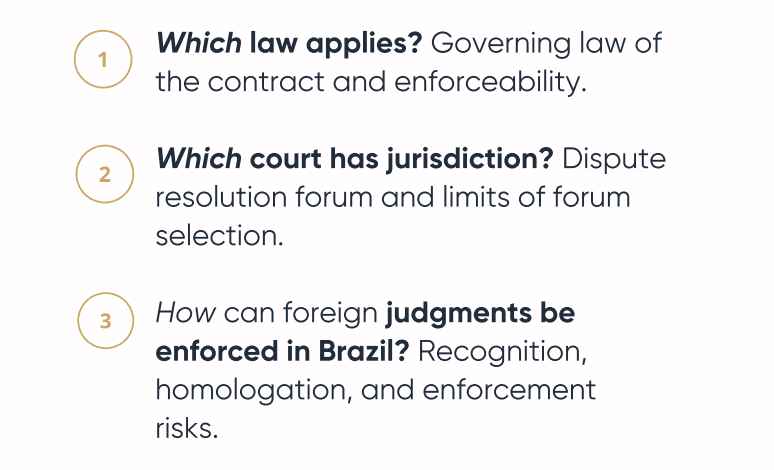
Key Questions in Cross-Border Financing
Conflict of International Laws
In structured trade finance, conflict-of-laws rules are critical because they:
Define the applicable law for cross-border contracts.
Affect the validity of rights and obligations under financing and security instruments.
May impose different regimes on guarantees compared to the main contract.
Conflict of Laws in Brazil
Brazilian private international law recognizes party autonomy, allowing parties to choose governing law and jurisdiction. This choice must, however, respect Brazil’s mandatory conflict-of-law rules (Arts. 7–19, Decree-Law 4,657/1942 – LI).
Lex loci celebrationis (Art. 9): contracts follow the law of the place of creation (usually signing).
Special rule (Art. 9, §2): obligations by absent parties may follow the law where the credit was offered.
Exceptions (Art. 8): goods in transit → owner’s domicile; pledges → possessor’s domicile.
Foreign law may be chosen if consistent with these principles and not contrary to sovereignty or public policy.
Choice of Forum in International Agreements
Civil Code (Art. 78): parties may stipulate the forum.
CPC (Art. 25): validates foreign exclusive jurisdiction clauses, except where Brazilian courts have exclusive jurisdiction (e.g., pledged assets in Brazil – Art. 12, §1 LI; Art. 89 CPC).
Law 14.879/2024 (Art. 63, §1 CPC): forum clauses (including foreign) must show a “relevant link” to a party’s domicile or the place of performance.
Because Art. 25 is tied to Art. 63, judges may now reject forum clauses lacking a clear nexus.
Key Case Law (2024–2025)
Transitional rule: clauses signed before June 2024 remain valid.
Commercial contracts: STJ upheld clauses where there is a substantial nexus (e.g., branch, place of signing).
Pre-reform contracts: TJSP confirmed a foreign forum in shipping, stressing good faith and contractual freedom.
→ Superior Court of Justice (STJ): Brazil’s highest appellate court for non-constitutional matters, including recognition of foreign judgments and arbitral awards.
Recognition & Enforcement of Foreign Judgments
Enforcement in Brazil requires that judgments are:
Final and issued by a competent court.
Parties were duly summoned or default declared.
Formalities of the original jurisdiction observed.
Translated by a sworn translator.
Homologated by the STJ.
This process is often time-consuming, raising risks that debtors dissipate assets before enforcement.
Judicial Landscape & Institutional Considerations in Brazil
Proceedings can be lengthy, with multiple appeals.
Predictability requires careful structuring of financing agreements.
Brazil has advanced in arbitration and international cooperation, offering more security to lenders.
Courts have also improved technology for quicker asset seizure and enforcement.
When borrower assets are in Brazil, lenders should combine domestic enforceability with international best practices.
Practical Recommendation: Arbitration
Arbitration is a trusted and efficient mechanism for financing disputes, aligning global standards with the Brazilian Arbitration Act:
Party autonomy: freedom to choose law, institution, and seat (Art. 2).
Efficiency: faster proceedings, expert adjudication, and finality.
Enforceability: awards recognized under the New York Convention; STJ homologation required only for foreign awards.
Strategic Advantage: Brazil-Seated Arbitration
Domestic awards are immediately enforceable, with no STJ homologation.
Parties may still apply foreign substantive law (e.g., English law).
This hybrid ensures international standards plus direct enforceability in Brazil.
Key Takeaways for Financing Brazilian Counterparties
Brazil permits foreign law and jurisdiction, but forum clauses are now subject to a “relevance” test.
Recognition of foreign judgments can be lengthy, highlighting the need for well-structured dispute resolution.
Arbitration — ideally seated in Brazil — offers the most reliable balance of enforceability and certainty.
Notes:
Many lenders already accept Brazilian law for facility agreements. Security agreements (e.g., pledges) must in any case follow Brazilian law, with exclusive jurisdiction of Brazilian courts. Aligning the loan agreement under Brazilian law often ensures smoother enforceability.
Drafting a robust arbitration clause (arbitrators, seat, language, institution, rules, applicable law) is crucial. Poor drafting may invite court challenges, undermining the efficiency arbitration is meant to deliver.
Stay tuned for more insights on structuring cross-border financing efficiently and mitigating institutional risks when lending to Brazilian counterparties.