Brazil is EUDR-ready
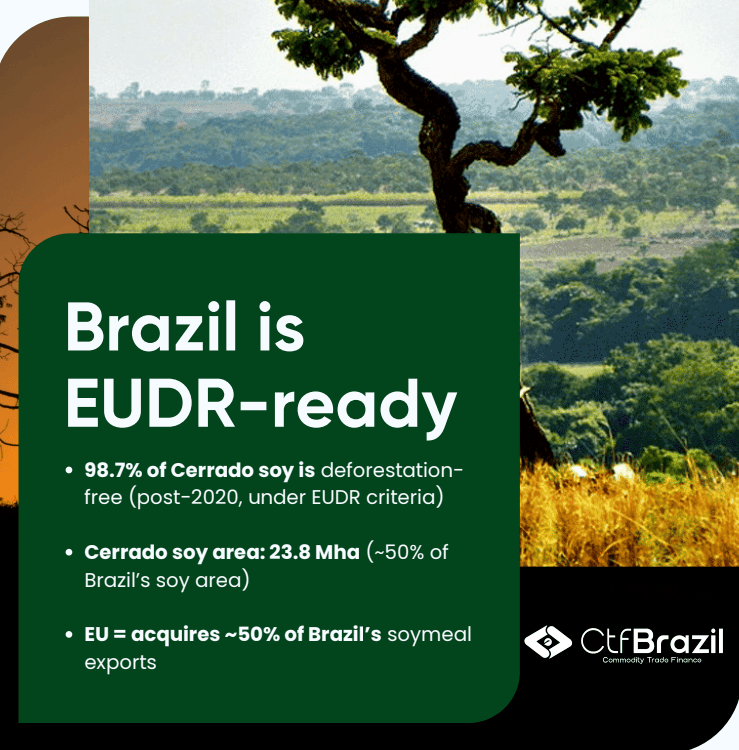
98.7% of Cerrado soy is deforestation-free (post-2020, under EUDR criteria)
Cerrado soy area: 23.8 Mha (~50% of Brazil’s soy area)
EU = acquires ~50% of Brazil’s soymeal exports
What is the Cerrado?
The Cerrado — is Brazil’s vast tropical savanna biome — is both a biodiversity hotspot and the country’s agricultural frontier, producing over 50% of soy, spanning about 200 million hectares across central Brazil.
🌍 Size: Second-largest biome in South America (after the Amazon).
🌱 Nature: A mosaic of grasslands, shrublands, and forests — sometimes called the “upside-down forest” because most biomass and carbon are stored in deep root systems.
🐆 Biodiversity: One of the richest ecosystems in the world, home to species like the maned wolf, giant anteater, and jaguar.
🌾 Agriculture: Brazil’s main agricultural frontier, producing over 50% of the country’s soybeans, along with corn, cotton, and beef.
Because it combines ecological importance with a strategic role in global food supply, the Cerrado is central to the debate on sustainable agriculture and EUDR compliance.
🔎 Where is expansion happening?
In the last 3 harvests, most new soy area came from pastures, fallow land, or crop rotation.
Only 316.9k ha came from conversion of native vegetation. Actual non-compliance is therefore even lower than 1.3%.
Other States (17.85 Mha, 75% of Cerrado soy area): 99.7% deforestation-free post-2020.
MATOPIBA (5.99 Mha, 25% of Cerrado soy area): 95.7% deforestation-free post-2020.
🔎 Expansion hotspot – MATOPIBA: acronym for Maranhão, Tocantins, Piauí, and Bahia. Mainly in the Cerrado biome and transition zones with the Amazon, this frontier has seen rapid adoption of high-tech annual agriculture, driving landscape transformation. (Note: the small MATOPIBA portion within the Amazon biome was excluded from the study.) (source: 📖 Source: Serasa Experian & Abiove, 2025.
EUDR explained
The EU Deforestation Regulation (EUDR) aims to eliminate the EU’s contribution to GHG emissions from forest conversion.
Cut-off date: 31 December 2020.
Commodities: soy, cattle, cocoa, coffee, oil palm, rubber, and byproducts.
Legal compliance: Products must be produced in line with the laws of the country of origin.
Obligation: Importers must submit a due diligence statement proving products are deforestation-free post-2020, or face sanctions.
Definition: EUDR considers only forest vegetation (not all native vegetation)
Timeline: Rules apply from 30 Dec 2025 for large enterprises and 30 Jun 2026 for SMEs.
What this means for trade finance:
With nearly all soy EUDR-compliant, financiers can feel secure supporting Brazilian-origin exports.
Strengthening traceability and certification systems not only reduces risk, but also increases the attractiveness of Brazil’s export flows in the eyes of global lenders and investors.
✅ With robust monitoring and nearly all soy already compliant, Brazil is structurally positioned to remain the world’s leading supplier of sustainable soy.
The next step: traceability, certification, and logistics.